

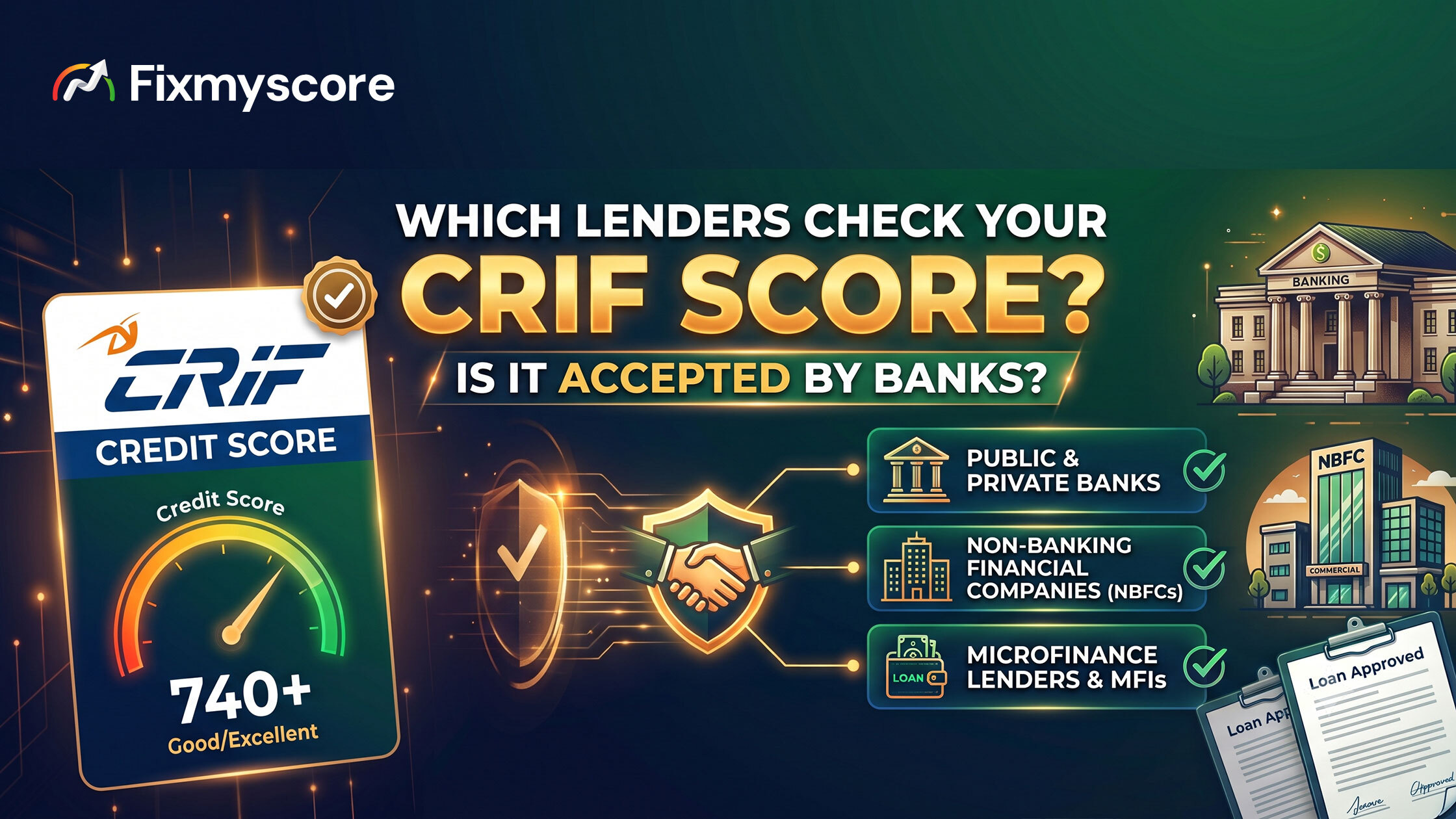
Yes, banks accept a CRIF score. CRIF High Mark is one of four credit bureaus licensed by the Reserve Bank of India, and RBI rules require every bank and NBFC to be a member of all four. That means any regulated lender you apply to can pull your CRIF report. Which bureau they actually check is their own decision, and most don't publish it, but you can usually find out after the fact.
New to CRIF? Our CRIF score guide covers what the score is and how it's calculated.
Why every lender can see your CRIF report
In February 2015, the RBI told all credit institutions to become members of every credit information company in India, not just one. Before that, many lenders reported to only one or two bureaus, which left gaps in people's records. The RBI's 2025 credit information reporting directions repeat the rule for banks, NBFCs, small finance banks and other regulated lenders, and asset reconstruction companies were brought under the same requirement in 2024.
In practice, this works in two directions:
- Lenders send your data to CRIF. Your EMIs, card payments and loan closures are reported to CRIF High Mark just as they are to CIBIL.
- Lenders can pull your CRIF report. Membership gives them access, so a CRIF report is always an option when they assess you.
So a lender reading your CRIF score isn't using some second-tier source. It's using a record that it helped build.
Lenders most likely to look at your CRIF score
No lender is limited to one bureau, but some parts of the market lean on CRIF High Mark more than others.
NBFCs and digital lenders
Non-banking lenders cover a lot of borrowers that banks don't reach, and CRIF has strong coverage in exactly this space. If you're applying for a personal loan through an app or for a consumer durable loan at a shop, there's a fair chance your CRIF report is part of the check.
Microfinance institutions and small finance banks
CRIF High Mark has a long track record with microfinance data, including loans made to members of self-help groups. Lenders in this segment use bureau data to see how many loans a borrower already has before approving another.
MSME and business lenders
When a small business borrows, the lender often reads the owner's personal credit report alongside the business's credit record. CRIF High Mark offers both commercial and consumer reports, which is one reason it features in MSME lending.
Banks
Large banks tend to use more than one bureau, sometimes by product, sometimes to cross-check. A bank might pull CIBIL for one application and CRIF for another, or both for a big-ticket loan. Your CRIF report can matter even if you only ever borrow from a bank.
How different lenders use your CRIF report
Why a lender picks CRIF, or pulls more than one bureau
Lenders don't explain their bureau choices publicly, but the usual reasons are practical ones:
- Coverage. Some bureaus hold richer data on certain kinds of borrowers, such as first-time borrowers, rural customers or microfinance clients.
- Cost and contracts. Bureaus charge per report, and lenders often negotiate volume deals with one or two of them.
- Risk policy. Some lenders pull two bureaus on purpose and go with the lower score, especially for unsecured loans.
- Product fit. A lender might use one bureau for cards and another for business loans, depending on how well each one's score predicts defaults in that product.
From your side, the takeaway is the same every time: you can't choose the bureau, so your CRIF report needs to be as clean as your CIBIL report.
How to find out which bureau checked you
You don't have to guess. There are three reliable ways to tell.
- Watch for the bureau's alert. Under the RBI's 2025 directions, credit bureaus have to notify you by SMS or email when a lender views your credit report. The message tells you which bureau was accessed.
- Read the enquiries section. Every report lists the hard enquiries made on it, with the lender's name and the date. If a lender shows up on your CRIF report, it pulled CRIF.
- Ask the lender. Loan officers will often tell you which bureau report they're looking at, especially if your application is on hold or has been declined. It's a fair question to ask.
What this means before you apply
A little preparation keeps an avoidable surprise from costing you a loan.
- Check your CRIF report a few weeks before applying. That leaves time to fix an error before a lender sees it.
- Compare it with at least one other bureau. If your CRIF and CIBIL scores are far apart, find out why first. Our guide on CRIF vs CIBIL explains what to look for.
- Don't apply to several lenders at once. Each application adds a hard enquiry, and if they all pull CRIF, the enquiries stack up on one report.
- Work on the score first if it's low. Here's how to improve your CRIF score in the months before you apply.
- Time your payments. Lenders now report to bureaus on the 9th, 16th, 23rd and last day of each month. If you clear a card balance just after a reporting date, give it about a week to show before you apply.
- Know where you stand. A CRIF score of 730 or more generally gets approved easily, and 750 or more gets the best rates. See the full CRIF score range.
Frequently asked questions
Q.1 Is CRIF score accepted by banks in India?
Yes. CRIF High Mark is licensed by the Reserve Bank of India, and every bank and NBFC is required to be a member of all four credit bureaus, including CRIF. Any regulated lender can check your CRIF score.
Q.2 Which banks use CRIF High Mark?
Banks don't usually publish which bureau they use, and many use more than one. Because all regulated lenders are CRIF members, any bank can pull your CRIF report. The bureau's SMS or email alert, or the enquiries section of your report, will tell you when one did.
Q.3 Do NBFCs check CRIF score?
Many do. CRIF High Mark has strong coverage of NBFC, microfinance and MSME lending, so NBFCs and digital lenders frequently use CRIF reports, sometimes alongside another bureau.
Q.4 Can I ask a lender to use my CIBIL score instead of CRIF?
You can ask, but the lender decides. Most follow a fixed internal policy on which bureau to check. It's safer to make sure both reports are accurate before you apply.
Q.5 How do I know if a lender checked my CRIF report?
Look for an SMS or email from CRIF High Mark, which bureaus must send when a lender views your report, and check the enquiries section of your CRIF report for the lender's name and date.
Check your CRIF score free
FixMyScore pulls your full CRIF High Mark report, shows which accounts are costing you points, and gives you a plan to fix them. Checking is a soft inquiry, so it never lowers your score. Check your CRIF report free, or get the app on Google Play or the App Store.
Sources: RBI directive requiring credit institutions to become members of all CICs (February 2015); RBI Credit Information Reporting Directions, 2025; RBI circular on submission of information to CICs by ARCs (October 2024).